Material Classification of Rebar Cutting Machine Knife and Their Differences
Rebar cutting machine knife are critical components that directly affect cutting efficiency, cutting quality, machine performance, and maintenance costs. Different blade materials offer different levels of hardness, toughness, wear resistance, and impact resistance. Selecting the right blade material according to the type, diameter, and strength of the steel bar is essential for reliable cutting performance.
1. Common Materials Used for Rebar Cutting Machine Knife
1. Carbon Tool Steel
Carbon tool steel is a relatively economical material used for some light-duty cutting applications. It can achieve high hardness after heat treatment and is suitable for cutting smaller-diameter steel bars under moderate working conditions.
-
Advantages: Low cost, easy processing, and straightforward heat treatment.
-
Disadvantages: Lower wear resistance and heat resistance than many alloy tool steels; toughness may be insufficient for heavy-duty cutting.
-
Best suited for: Light-duty machines and applications with relatively low cutting loads.
2. Alloy Tool Steel
Alloy tool steel contains elements such as chromium, molybdenum, and vanadium, depending on the grade. These alloying elements can improve hardenability, wear resistance, strength, and toughness when the material is properly heat-treated.
-
Advantages: Good balance of hardness, toughness, and service life.
-
Disadvantages: More expensive than ordinary carbon tool steel; performance depends heavily on the specific grade and heat treatment.
-
Best suited for: General-purpose rebar cutting machines used on construction sites and in steel processing facilities.
3. High-Chromium Cold-Work Tool Steel (Cr12MoV and Similar Grades)
Cr12MoV is a high-chromium cold-work tool steel commonly used for wear-resistant tooling. With appropriate heat treatment, it can provide high hardness and good resistance to abrasive wear.
-
Advantages: High wear resistance, good dimensional stability, and potentially long service life.
-
Disadvantages: Can be susceptible to chipping or cracking if toughness, blade geometry, or heat treatment is inadequate.
-
Best suited for: Rebar cutting machines operating under demanding conditions, provided the blade design and steel grade are suitable.
4. High-Speed Steel (HSS)
High-speed steel contains alloying elements such as tungsten, molybdenum, chromium, and vanadium in varying combinations. It is designed to maintain hardness under elevated temperatures and can provide excellent wear resistance.
-
Advantages: High hardness, good wear resistance, and better hot-hardness retention than many conventional tool steels.
-
Disadvantages: Higher material and manufacturing costs; not automatically superior for impact-loaded rebar cutting applications.
-
Best suited for: Specialized cutting applications where the blade design, operating conditions, and economics justify its use.
2. Comparison of Different Blade Materials
| Material | Wear resistance | Toughness | Relative cost | Typical application |
|---|---|---|---|---|
| Carbon tool steel | Low to moderate | Grade-dependent | Low | Light-duty cutting |
| Alloy tool steel | Moderate to high | Moderate to high | Medium | General construction use |
| Cr12MoV and similar cold-work steels | High | Grade- and treatment-dependent | Medium to high | Demanding cutting conditions |
| High-speed steel (HSS) | High to very high | Grade-dependent | High | Specialized applications |
These are general comparisons, not guaranteed rankings. Actual performance depends on the exact steel grade, hardness, heat treatment, blade geometry, and cutting conditions.
3. How Does Blade Hardness Affect Cutting Performance?
Hardness is an important factor, but it is not the only factor determining blade quality.
-
Insufficient hardness: The cutting edge may wear quickly, deform, or become blunt, reducing cutting efficiency.
-
Excessive hardness with insufficient toughness: The blade may chip or crack under repeated impact loads.
-
Balanced hardness and toughness: The blade can maintain a sharp cutting edge while resisting damage during repeated cutting cycles.
For this reason, manufacturers must carefully control the heat-treatment process. Surface quality, dimensional accuracy, cutting-edge geometry, and proper installation also influence blade life.
4. How to Choose the Right Rebar Cutting Machine Blade
When purchasing replacement blades, consider the following factors:
-
Steel bar diameter: Larger-diameter bars generally require greater cutting force and place higher loads on the blades.
-
Steel grade and strength: High-strength or high-tensile reinforcing bars may require more demanding cutting performance than ordinary mild steel bars.
-
Cutting frequency: Machines operating continuously or at high production volumes benefit from blades with suitable wear resistance and fatigue performance.
-
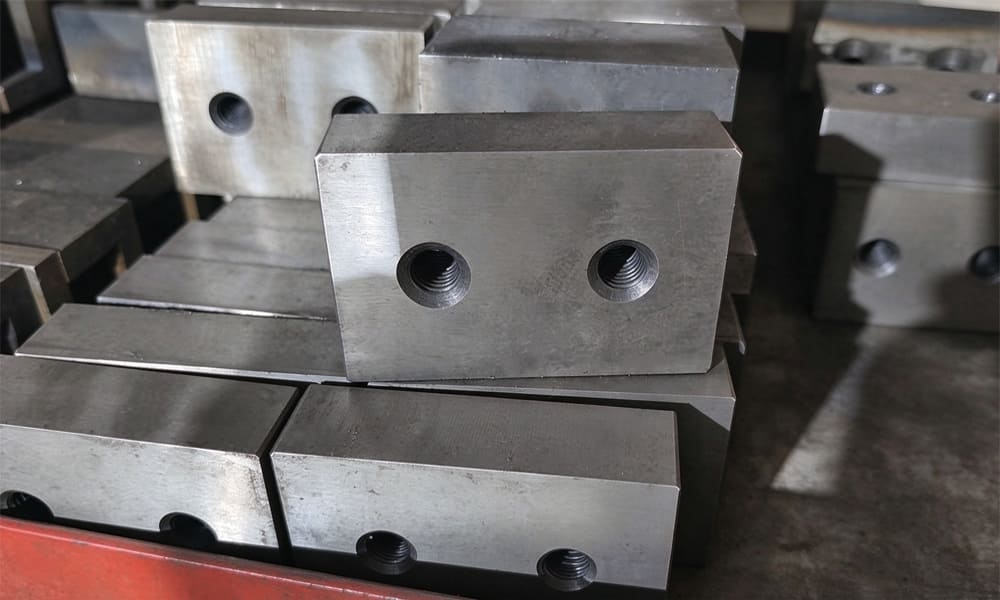
Machine model: Blade dimensions, mounting holes, thickness, and cutting geometry must match the machine.
-
Total operating cost: A more expensive blade may offer better value if it delivers a longer service life and reduces machine downtime.
Never select a blade based on hardness alone. A blade that is too brittle can fail prematurely, even if its hardness is high.
5. Conclusion
The main differences between rebar cutting machine blade materials lie in their hardness, wear resistance, toughness, manufacturing cost, and suitability for different working conditions. Carbon tool steel offers an economical option for light-duty applications, while alloy tool steel provides a practical balance for general construction work. Cr12MoV and other high-chromium cold-work steels can provide excellent wear resistance, whereas high-speed steel is more appropriate for selected specialized applications.
For most construction machinery users, the best choice is not necessarily the hardest or most expensive blade. It is the blade made from a suitable material, correctly heat-treated, and matched to the machine and the steel bars being cut.